Showing posts with label novel. Show all posts

Tuesday, 21 April 2020

Lockdown Literature 3.1


Hello again,

 
I hope you had a good Easter. 
 
Thanks for all the emails with photos of your work. I thought that last task might have been a bit tricky, but you seem to have got it! A few of you need to go back and check that you've done the work from last time.


Here’s this week’s work (for Friday):


2) Use some of the links below to revise the Gothic genre. 
Focus on the resources in bold. The others are optional extras:


3) Write a single paragraph about Dickens’s use of gothic language and imagery in Chapter 38. 

You should use at least three quotations. I have given you instructions and a topic sentence to start with on the doc below. This task should only take 15 minutes or so: five minutes to find your quotes and ten minutes to write. You can work on this Google doc, the Word doc below or in your book. 


4) Read Chapter 39 of Great Expectations by Friday.
It’s a very important one! I’ll send notes on this chapter later today – or possibly tomorrow.

I hope this all makes sense. I think I’ve given you about an hour’s work here (5 minutes for task 1; 10-15 minutes for task 2, 15 minutes for task 3, 20-25 minutes for the reading.)

Let me know if you need anything.

Mr M

Wednesday, 6 March 2019

Great Expectations: Themes and Motifs

Hi folks,

Here are your notes based on the JILES themes.

It's be a good idea for you to use these ideas to start creating your own notes on each theme. Don't forget to use the JILES conclusions sheet to think about the kind of conclusions which might constitute a 'conceptualised response'.

Here they are (click to enlarge):


Sunday, 20 May 2018

Bildungsroman: a recap

Hi,

It's probably the easiest and most useful way of getting into context when writing about Great Expectations. If you get a question about Pip - or a question where Pip is important - then you've got to mention the literary context of bildungsroman.


Here's a reminder of what it is:


Now think of Pip.

At the start of the novel, the marshes and the forge are all he knows. The symbolic 'horizontal lines' that he sees as the horizon in Chapter 1 represent his limited expectations and his bleak prospects.

When he goes to Satis House, everything changes. His horizons suddenly expand. But he also starts to feel 'coarse and common'. He is no longer content to be a blacksmith. This loss of identity leads his on a quest to improve himself and make himself worthy of Estella.

He makes lots of mistakes along the way. He becomes a bit of a snob, he rejects Joe, he gets into debt; in the the middle chapters, he faces humiliation after humiliation. These are all part and parcel of the learning process of bildungsroman.

In the end, Pip is able to move on from the haunting presence of Miss Havisham and Satis House, and he's forced to let go of any hope of being with Estella. He recognises Joe as a 'gentle Christian man', he recognises that Joe is more worthy of Biddy's hand, and he accepts a job. He accepts his limitations and his place in the world. He learns, from Herbert's example, the virtues of hard work and 'looking about you' for an opportunity - and gets over the idea that some benefactor can make his dreams come true. By the end, he redeems himself - and perhaps he earns the half-chance of happiness with Estella - if that is what Dickens suggests at the end.


Hope this helps,


Mr M

Saturday, 19 May 2018

Context: Great Expectations and Macbeth

Hi folks,

Remember, according to AQA, if you're answering the question (by really focusing on the key word(s)) then you're doing context. However, here's a reminder of some of the contexts that might be relevant (click to enlarge):


Tuesday, 15 May 2018

Great Expectations - Themes/Motifs

Hi all,

This is overdue, but here are your theme/motif posters on Great Expectations.


Monday, 2 April 2018

ClicDickens

Hi folks,

Check out this new concordance of the works of Dickens from the University of Birmingham. 

It allows you to search for words in the text so that you can find related quotes and extracts. It looks much better than the one I showed you in class.

Here's just a little of what came up when I searched for 'hands coarse common' (click to enlarge):


This tool could be very useful if you are putting together notes on a theme. For example, if you are revising 'justice', try searching for 'law justice crime guilt court'. In fact, here's what you get if you do just that:


As you can see, you can sort the results in various different ways. You can also see chapter numbers and can browse the examples in the online text.

Give it a whirl.


Mr M


Thursday, 20 October 2016

Half-term revision

Oh hi,

This half-term, I just want you to read and revise! You have four exams to prepare for, so leaving it until after Christmas will leave you with too much to cram into your head in just over a term. Spacing out practice and interleaving revision is proven to help with long-term memory.

With that in mind, here's the advice that I gave you before the summer:


Suggested summer revision activities:

1.    Re-read An Inspector Calls
2.    Revise key quotes on Quizlet
3.    a) Re-read Great Expectations, or…
b) Re-read key chapters from Great Expectations (see below) and annotate text
4.  Re-read the six poems studied so far in the poetry anthology


Useful websites:

·       www.wemmickspostbox.blogspot.co.uk (all other links can be found here)


Key chapters (Great Expectations)

·       Chapters 1-5 (Pip and the convict)
·       Chapter 8 (Miss Havisham and Satis House)
·       Chapter 11 (the pale young gentleman)
·       Chapter 14 (growing up at the forge)
·       Chapters 19 and 20 (leaving for London)
·       Chapter 27 (Joe’s visit)
·       Chapter 29 (the return of Estella)
·       Chapter 35 (Mrs Joe’s funeral)
·       Chapter 39 (Return of the convict)
·       Chapter 42 (Magwitch’s story)
·       Chapter 44 (Satis House: Pip’s declaration of love)
·       Chapter 48 and 49 (Molly’s story; back to Satis House)
·       Chapter 53 (Encounter with Orlick) and 54 (the steamer)
·       Chapter 56 (the trial)
·       Chapter 57 (Pip’s illness) and 59 (the ending)


It might be a good idea to try to find an audiobook version of Great Expectations to help you. If you find one somewhere, please let me know so I can share a link. I'd still advise you to re-read key chapters however. Seeing the text makes a difference.

Don't forget An Inspector Calls either. You could easily re-read it in a couple of hours. 

In my next post, I'll share some great sites for helping you study Macbeth. In the meantime, don't forget about this


Happy half-term,

Mr M


PS. I know you're reading this, Beth.


Wednesday, 29 June 2016

The 19th Century Novel: Finding Quotes

Hi,

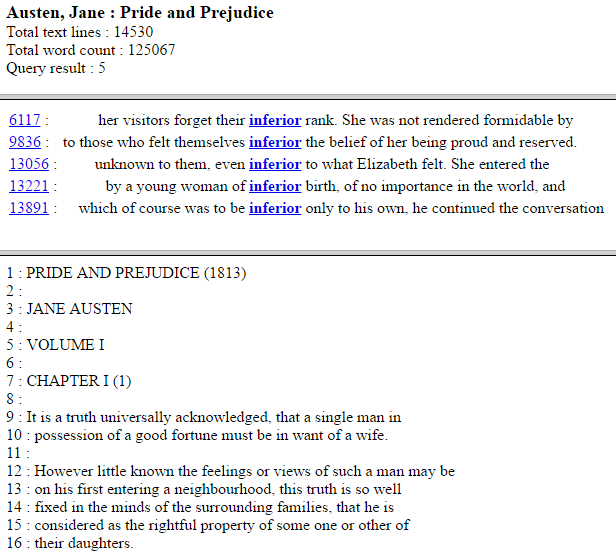
If there's a quote you're looking for in your 19th Century novel, but you have no idea where to find it, try this...

The Victorian Literary Studies Archive

Here's what you do:

1) Find your text (eg. Austen, Pride and Prejudice)
2) Think of a word in your quote to search for (eg. inferior)
3) You will be shown a list of every occurrence of the word in the text. Like this:


Ta-da - you've found your missing quote.

Use these links to get straight to your class text: Pride and Prejudice, Great Expectations, A Christmas Carol.


Mr M


Thursday, 23 June 2016

Exploring context: Great Expectations

Hi folks,


We've done plenty of work on the context of Great Expectations, but there's a lot of useful stuff out there for you to develop your knowledge further.

This collection of articles from the Victorian Web is particularly useful.

You can find the rest of the Victorian Web's stuff on Great Expectations here.

The British Library site is also great for context. They have sections on Romantics and Victorians and the Victorian Novel.

The National Archives has a section on Victorian Britain, as well as individual lessons on Prisons and Crime and Punishment.

Get exploring!


Mr M